
Donations made to IxD&A stem from the authors’ growing awareness of the need to share responsibility for the journal, its development, and what it represents – through its initiatives – for the relevant scientific community and for society as a whole.
For this reason, the publisher and the editorial board felt it was appropriate and necessary to provide an ongoing public report on the amount of donations received and how they are being used.
The bar chart shown here illustrates the trend in donations received following the publication of issue No. 68.
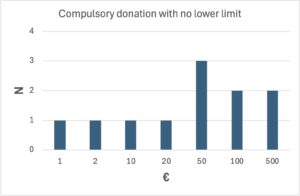
The trend in donations will be updated every 4–6 months.
The publisher and the editorial board has decided to use the donations received to date, and those to be received in the future, for the following purposes:
• covering the costs of DOI registration
• covering the annual subscriptions to applications/plug-ins that enable:
– the instant translation of web pages;
– the voice synthesis of the text;
– the operation of the bot dedicated to exploring the journal’s web content and articles;
– the experimentation with the multi-channel communication of the articles published by the journal to make its content more accessible and immediate, whilst maintaining rigour in their dissemination.
In addition to these uses, the publisher and the editorial board have decided to establish a € 500 prize for the Human Innovator Agent of the Year, in recognition of the student or early career researcher (under 35 years of age) whose contribution published in the IxD&A Journal has most distinguished itself, in the year of reference, for its level of technological and/or methodological and/or theoretical innovation and, therefore, for its ability to make a mark and serve as an inspiration for future research.
The first prize of the series will be assigned immediately after the publication of issue 71; it will therefore consider articles published by student first authors in published during the year 2026, i.e. in issues 68–71. The prize cannot be combined with prizes awarded by the SLERD conference.
Should donations of a sufficiently large amount become available, the publisher and editorial Board reserve the right to increase the number of prizes to recognise the contribution provided in the various categories: technological, methodological and theoretical.
The remaining amount of the donations will be set aside to fund projects by students and early-career researchers who wish to propose and develop new editorial services that the journal could offer to enhance the author and reader experience of IxD&A.